Showing posts with label Appreciating Other Art. Show all posts

Sunday, 6 March 2011

Focus on Imaging

Went to Focus On Imaging today. It was good, Canon had pulled out which was a bit of a shame, as I am a canon fanboy! But the expo was good, I listened to a few demonstrations but it was more hard sell than educational.


This is my favourite image from the day, which I have played around with in photoshop. I didn't take my SLR and there werent many photo opportunities.

Thursday, 6 January 2011

Lowry Favourites

I went to the Lowry Favourites exhibition the other day and it was really great. I have to say that the Lowry Gallery in Salford is a great place.
The exhibition was interesting as this is the first art exhibition of paintings I have been to see since starting TOAP so it was nice to look at the structures and techniques that had been used and compare them to some of the techniques that I have been learning.
There is a definite correlation between some of the elements of design in section 2 and Lowry's paintings. He uses movement and eye lines a lot, even on his crowd scenes where the figures are quite simplified. He also uses rhythm and pattern quite a lot with his chimneys and mill paintings.
The paintings that affected me the most were the sea scapes which I have never seen before. The are so simple, but so bleak, and on reading that they reflected his lonliness at the time I must admit I felt quite depressed!
I'm not sure how engaging they would be as photographs, but the next time I am at the coast I will definately try to capture a landscape made up of just sea, sky and horizon.


Tuesday, 28 December 2010

Photographer Awareness

Henri Cartier-Bresson - portraits


Biography
Born August 22, 1908 and died August 3, 2004. A French photographer who toured America with his exhibitions


What was he famous for?
Being the Father of Photojournalism. He was one of the first professional photographers to use the 35mm format and he helped develop street photography


Interesting Facts
He founded the Magnum Photos co-op with Robert Capa, David Seymour, and George Rodger


Photograph that most speaks to me


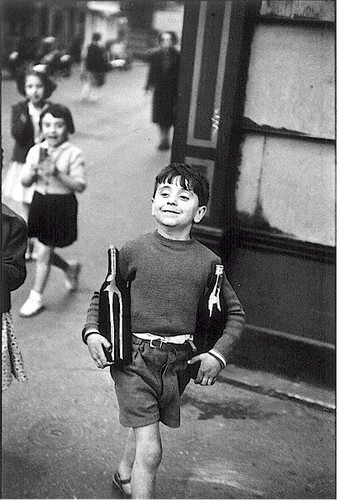
I love the expression of satisfaction on the young boys face as he carries the bottles. The composition works effortlessly as his motion is perpetuated by the angle of the frame.


Alexander Rodchenko - montage and alternative angles


Biography
Born 5 December 1891 died December 3, 1956


What was he famous for?
Using odd angles to postpone recognition


Interesting Facts
He wanted to liberate photography from conventions and from the standard belly-button perspective and thus he evolved into a distinct pioneer of photographic Constructivism


Photograph that most speaks to me

Girl with Leica - I like this because the eye follows the pattern first before it recognises the woman sitting on the bench, in fact the camera is the last thing you notice.


Duane Michals - photo sequences


Biography
born February 18, 1932, still living


What was he famous for?
He is famous for using sequences of photos to tell stories


Interesting Facts
He didn't use a studio which made him stand out from


Photograph that most speaks to me

The Dream Of Flowers - I like this one because even though I don't generally like his staged sequences, this one seems to flow better and whilst the flowers are clearly placed, the placement has been done well so it does suggest the man is falling deeper into sleep.


Peter Keetman - abstracts
Biography
Born April 27th 1916 in Elberfeld , died March 8 2005 in Marquartstein


What was he famous for?
Water drops and abstracts


Interesting Facts
He was one of the founder-members of the Fotoform group in 1949 with OTTO STEINERT and others.


Photograph that most speaks to me


I really like this shot, the image merges abstract and reality in a way i haven't really seen before.

Thursday, 9 December 2010

Richard Avedon

Another short post I'm afraid, things are manic and the moment. I'm currently working on my colour ratio exercise but a wedding last weekend has meant a week of photo editing.
On with the photographers.

Biography
Born in New York in 1923, died in 2004.

What was he famous for?
Celebrity portraits

Interesting Facts
In the 1960s Avedon branched out into photo-journalism and recorded the Civil Rights movement, Vietnam at war and paitents in mental hospitals.

Photograph that most speaks to me

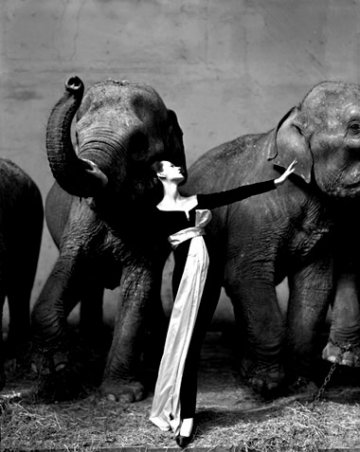
I love this image, I like the dynamic movements of the elephants and the posed, dignity of the model.

Thursday, 18 November 2010

Ansel Adams

Due to generally being swamped I've decided to approach my write-ups of historical photographers in a quick fire way, so I'll use the same headings for each one I planned to research.

Biography
Born in America in 1902, died in 1984. 

What was he famous for?
Landscape photography and creating the zone system for better exposure and contrast in printing

Interesting Facts
Adams founded the Group f/64 along with fellow photographers Edward Weston and Imogen Cunningham - dedicated to sharp, detailed and accurate photography.

Photograph that most speaks to me

Mainly due to the dramatic sky and the way the curves of the river help the eye roam around the image.

Monday, 8 November 2010

Photographer Awareness

One of the reasons why I wanted to do this course was to explore and understand the work of famous photographers and be able to appraise a photograph from an artistic viewpoint. With this in mind, I'm still working my way through the Graham Clarke book but whilst I am enjoying the book, reading an academic work on a subject area that I was completely clueless about before, doesn't produce great understanding under my particular learning style.
So to address this I decided to widen my knowledge and I bought four Taschen books second hand off Amazon. The first one that I have started (and nearly finished) reading through is 20th Century Photography.


http://www.amazon.co.uk/20th-Century-Photography-Museum-Cologne/dp/3836507811/ref=sr_1_2?s=books&ie=UTF8&qid=1289247681&sr=1-2


This book is ideal for where I am right now, it contains 1/2 pages of information about nearly 50 photographers who are deemed important to photographic art and who's work features at the Museum Ludwig in Cologne.


I've read through most of the book now and it's given me a good understanding of who was responsible for what and its also been nice to identify the creators of some of the photographs that I already knew. 
So with this in mind I have decided to blog about 6 of the photographers who's work is quite different from each other. This will be useful in helping me consider my own work in terms of their areas and also get some inspiration and ideas.


I'm going to look at:


Henri Cartier-Bresson - street
Ansel Adams - landscapes
Richard Avedon - portraits
Alexander Rodchenko - montage and alternative angles
Duane Michals - photo sequences
Peter keetman - abstracts


There are so many to pick from I just decided to pick the one's in the book who's work spoke to me immediately from an aesthetic viewpoint.

Thursday, 28 October 2010

Chapter 4

Just finished chapter four of Graham Clarke's The Photograph.
I'm really enjoying the book and it's great to have individual photos critiqued in detail so that we can learn to improve how we view photographs as art. I can totally understand why it is given as part of this course.
The last chapter did make me think though, I'm a massive fan of landscapes and I think that a landscape photograph can evoke more emotions and intrigue than any other subject matter, but I think that Graham Clarke may have given too much credit to some of the photographers and their intentions when taking the earlier photographs. A lot of early landscapes seem to have been commissions from governments which tells me that the photographers were fulfilling a brief and weren't simply creating art.
Not to say that there was no art in early photography, and Talbot , Fenton and Calvert Jones were certainly following painting traditions, but Clarke attributes a lot of social commentary to the photos and I don't think this was intentional. When Talbot took photos of his book shelf, it wasn't to produce an autobiographical commentary on his social standing, I imagine it was to practice his new technique, the same must surely be true of Daguerre.
This may come across as arrogant on my part and I don't mean to criticise Clarke's book or writing. Its just a thought that's been occurring to me.

Sunday, 10 October 2010

Philip Townsend

Yesterday I saw the Philip Townsend exhibition at the Lowry in Salford Quays where I was taking some pictures for the 'points' exercises.


The exhibition was really interesting, Townsend is one of the seminal sixties photographers who chose to take wider angled portraits and capture the context in which his subjects moved, mainly, sixties London. His contemporaries used tighter crops but Townsend wanted to show the area around the pop stars and models who featured in most of his shots.


What struck me was how much I preferred his candid shots rather than the popular ones of the Beatles and the Rolling Stones.
There is a great shot of two 60s policemen abroad frowning at a French newspaper.


I also liked the picture of Burton and Taylor at dinner surrounded by fans and letting their guard fall.


Whilst the exhibition was very inspiring, I ended up taking some industrial abstracts which I quite liked.


- Posted using BlogPress from my iPad

Wednesday, 29 September 2010

Cartier-Bresson

Recently I have been watching the BBC Genius of Photography series and whilst a lot of the famous photographers mentioned have struck a chord with me, I first wanted to think about Henri Cartier-Bresson a bit more.
He's considered to be the father of photo journalism and he took to that form of photography during a time when there was a lot of debate about the direction that photography should take as an art form.
Its really interesting that he didn;t believe in post production and that he was one of the first photographers to embrace 35mm. These are important facts to me because I too strive to achieve the best composition when the image is being captured and I also think that had cameras not become handheld, the art form would never have progressed.

He stuck to 50mm lenses which is interesting, I often think Ib stress about changing lenses to much, for a future task, I might restrict myself to a 50mm just to see how it goes.

I'm going to see if I can get a copy of, The Decisive Moment and see what inspiration I can draw from it. I certainly need to start looking at his images more as I love the classic, behind saint-lazare station, it totally appeals to me that he stuck his head through some railings to take it.

Monday, 13 September 2010

Saturday, 11 September 2010

Exhibition - Everyday People

Exhibition
Spencer Tunick's Everyday People

Spencer Tunick is a New York artist who uses the naked body to 'punctuate urban environments and natural landscapes'.
This exhibition was commissioned by the Lowry gallery and was shot in Manchester and Salford locations as part of Tunick's first multi-location project.

The car wash

The image showed rows of naked men queuing outside a dilapadated car wash. It's interesting that the shock factor of the nudity diminishes after a while. The queue seems to exaggerate the posture of the men to the point where theory seem to be leaning forward almost. They seem like a queue of infirm patients in some kind of abusive institution waiting to be hosed down.

The air hangar

This photo showed lines if men leaning toward each other standing up, with two rows of kneeling women, all are facing the same direction which is opposite to the plane that is in the background. There is a feeling of discomfort between the men leaning toward each other as they are avoiding any actual contact. The women kneeling seem to embrace their closeness and are touching in some places. The message here seems to be a comment on the closeness of women and the discomfort of men. I'm unsure. Why the location was chosen, perhaps because Manchester has an airport or perhaps because the planes is facing the opposite direction to the people it is some sort of comments on the different intention of people and technology. I didn't get a lot from this image I must say.

Peel Park

The frame of the image is almost square and is probably a ration of 5:4. This works as the centre of the image is a circular flower bed surrounded by circular pavement on which a circle of women walk, in a circle. these circular elements cause a pleasing motion and allows for the square crop. The set up of the shot is quite formal and the women are clearly arranged and the park is landscaped but the nudity and some branches at the top of the image give a feeling of nature. The artist has placed one black woman amongst around 100 white women at the front and she becomes the focal point and starting from her you follow her line of sight, and that of all the women around the circle. This adds to the feeling of movement.

Two Buses

The next exhibit was large landscape prints of old fashioned buses filled with naked ladies. The focus of the piece is boobs and bellies which are pressed against the glass windows of the bus. I didn't see the purpose of having two prints as ther was little variation between them and the bus was the same in both. The slogan on the side of the bus was Travel With Courtesy and this made the piece a visual pun commenting on busy commuter lives.

Castlefield

This exhibit was a portrait showing a small crowd of naked men shaking hands in front of a railway arch and next to a bridge with Beetham tower in the background. There was a focus on grey hair as it stood out and the men who were closer to the front of the piece had striking sliver grey hair. This was mirrored in the grey of the tower and the bridge to the right of the piece. The flesh tone of the men seemed to blend with the red brick of the railway arch making the men seem like part of their environment which seems to go against the grain of what the artist intends. The composition seems to be based on the long edges of the tower and the bridge legs.

Under the bridge

This exhibit was interesting from an exposure perspective as the scene is heavily and naturally vignettes by the shadow of the bridge from under which it was shot. The bridge also creates a frame within a am and it houses the shadowy nudes moving around in e foreground. The crowd of nudes gets busier further into the distance and as it does, the exposure is lighter until it becomes over exposed in the distance which almost creates a vanishing point.
The strong diagonal line of the bridge helps the eye cope with the figurers in the shadow as you are reminded yo look at the darkest corner of the frame where more figures can be found.

Eastlands

This exhibit had ten grounds of 30 people leaning forward in different directions. This almost makes the nudes look like prehistoric man but in a starkly urban environment. The portrait aspect of the frame makes the eye run up the image starting with the nearest group who are sharpest and ending at the top of the water tower. There has clearly been thoughtful composition to this shot but I don't fully appreciate the meaning of it.

Angel Meadow

This shot is framed by two dominant horizontal lines at the top and bottom of the picture, one a grass verge and the other tree branches. The eye is drawn to the mass of figures moving around and youvare then drawn, albeit erratically around the frame as you follow the directions that the different people are moving in. It may have been tempting to crop this tighter but it works well that it wasn't.

Overall Impressions

I started off trying to appraise these exhibits from an artistic viewpoint and then from a technical photographic viewpoint but after a while I started looking to see how techniques of framing, exposure and division have been used to artistic purpose. This is a new way of looking at photographic art for me as before now I have always looked at things from a purely technical standpoint.
I will admit that some of the meaning and concepts were lost on me, but after googling the aist on my return home, it is suggested that there isn't a lot of meaning to what he does. It's also interesting how this was called an installation rather than a photographic exhibition, which confuses me as the artist placed the models, took a photo and then packed up.